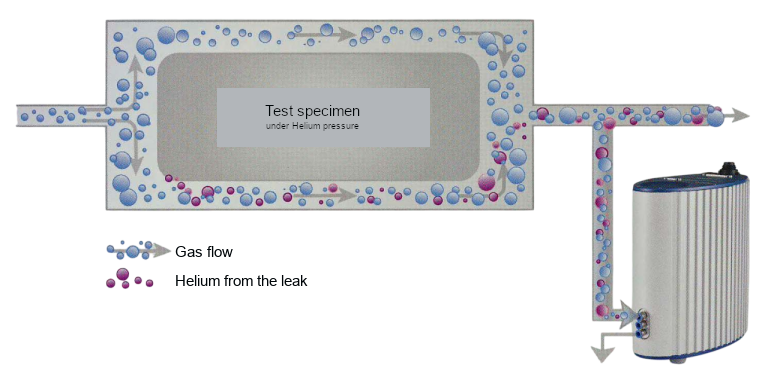
Helium leak testing using the accumulation method is a new procedure that has only recently been introduced to the market. Consequently, practical experience is still limited. However, the method was designed to combine the advantages of various other methods and minimize the known disadvantages of previous helium leak testing procedures.
Method:
The test object is sealed, filled with the test gas under test pressure, and surrounded by a shielding hood. The gas volume under the hood is continuously circulated to ensure uniform mixing of the test gas escaping through leaks under the hood with the air inside the hood. A portion of this gas mixture is continuously fed to the helium leak detector, which can detect even the slightest traces of the test gas.
A semi-permeable silicon membrane is used in the leak detector to increase the helium concentration in a special detection chamber sufficiently for detection to occur under ambient pressure. This also makes it possible to measure a slowly increasing concentration of the test gas, and the influence of a background concentration is less significant.
Test medium:
Helium (pure or in any mixing ratios with other gases)
detectable leak rates:
>0.0001 cm³/min
Advantages
- Very small leaks can be detected.
- The test method is simple to use.
- The test is carried out in an automated testing facility under defined temporal and pressure conditions. This makes the test results independent of the operator’s diligence and more reproducible.
- The temperature and elasticity of the test object have no influence on the test result.
- By correlating the gas concentration factor with the leak rate, this method enables a quantifiable leak rate determination.
- The test results can be automatically documented.
- The test chamber has a simple design, making it cost-effective, and no vacuum is required inside it.
- In the accumulation method, the increase in test gas within the test period is measured and evaluated. The influence of the natural helium content in the atmosphere and the issue of workplace contamination play a lesser role.
Disadvantages:
- Significant mechanical complexity for the test setup due to high-quality seals under a shielding hood. This complicates fault diagnosis in case of sealing problems.
- Risk of test gas contamination in case of incorrect operation or a gross leak.
- New method with limited practical experience.
Notes:
- Sufficient and complete filling of the test chamber with the test gas must be ensured. Therefore, the test chamber should be adequately flushed or first evacuated and then filled with the test gas.
- After testing, the test gas must be systematically removed from the workplace, otherwise, even with the accumulation method, a background concentration can build up over time, hindering work. Helium is the most critical of the known test gases concerning contamination issues.